Fareed Barakaفريد بركة
neuro-sonix
Neuro-Sonix
Text-to-music sonification engine
NeuroSonix turns alphabetic text into a full musical composition — pitch, rhythm, dynamics, and harmony — rendered straight to MIDI, to audio, and to a picture of the score. Idea conceived by Khaled Barakeh, developed and implemented by Fareed Baraka.
Rebuilt from the ground up: what began as a handful of hand-glued scripts producing one archival piece is now one real engine, extended to compose, synthesize, and visualize any text on its own.
View on GitHub Connect on LinkedInHow It Works
Pipeline
Harmony comes from a hand-authored Markov chain over functional-harmony tendencies, not a trained neural network — now with 7th chords, real cadences at the end of every sentence, and a walking bass line between chords. The audio is rendered by a built-in synthesizer tuned deliberately dreamy: soft-bloom attacks, unison chorus on every voice, notes that stretch into their own silences, a tempo-synced echo, and a large, dark reverb — with the noisier elements (a ticking hi-hat, breath hiss, hard bass drive) pulled back or removed. A finished piece never has to leave the pipeline for a DAW or soundfont.
- Text encoding — the original alphabet-to-pitch rule, unchanged since the first version
- Entropy-driven rhythm — letter rarity sets note length
- Phrase-arc dynamics — sentence-shaped velocity, not flat or random
- Melody-aware Markov harmony — chord choices that listen to the tune above them, with real voice leading between chords
- Extended chords & real cadences — 7ths where the function calls for them, every sentence pulled toward actually landing somewhere at its end
- Walking bass — a held chord hands off to a passing tone approaching the next chord's root, instead of one static note
- Seven-mode scale support — not just major and minor, with chord quality computed correctly for any of them
- Scale modulation — a piece can cycle through several modes sharing one tonic, one per sentence, instead of staying in a single key throughout
- Advanced arrangement — a parallel-harmony countermelody, an arpeggiated chord layer, and a soft sentence-marking chime, staged in across the piece rather than all at once
- A vocal choir — a wordless voice sung on the text's own vowels, given its timbre by a formant filter (fixed resonant bands modeling a vocal tract), independent of the note's own pitch
- Dreamy instrumentation — unison chorus on every voice, rubato-like note stretching, legato phrasing, a tempo-synced echo, and a large dark reverb, with the hi-hat, breath hiss, and hard bass drive of the previous pass pulled back or removed
- Batch automation — sonify a whole folder of text in one command
Try It Yourself
Interactive player
Play either demo piece back with a synced, animated piano roll — the melody, harmony, countermelody, arpeggio, bass, and percussion all moving together, with the source text highlighted letter by letter as it sounds.
Open the interactive playerA Missing Camera
The original piece, 2024
The composition that proved the concept: a testimony rendered note by note through NeuroSonix's original chromatic encoding.
A Missing Camera — NeuroSonix composition
Manifesto
New demonstration piece · chromatic melody
"Language becomes an instrument..." — a short text about the engine, sonified by the engine, in D minor, fully arranged: melody in blue, Markov-generated harmony in orange with real 7th chords and cadences (roman numerals mark each chord), a parallel-harmony countermelody in violet, an arpeggiated chord layer in gold, a walking bass line in green, and a soft chime marking each new sentence — all staged in gradually rather than playing from the first note, with legato phrasing, rubato-like note stretching, echo, and a large dark reverb giving it a dreamy, unhurried quality.
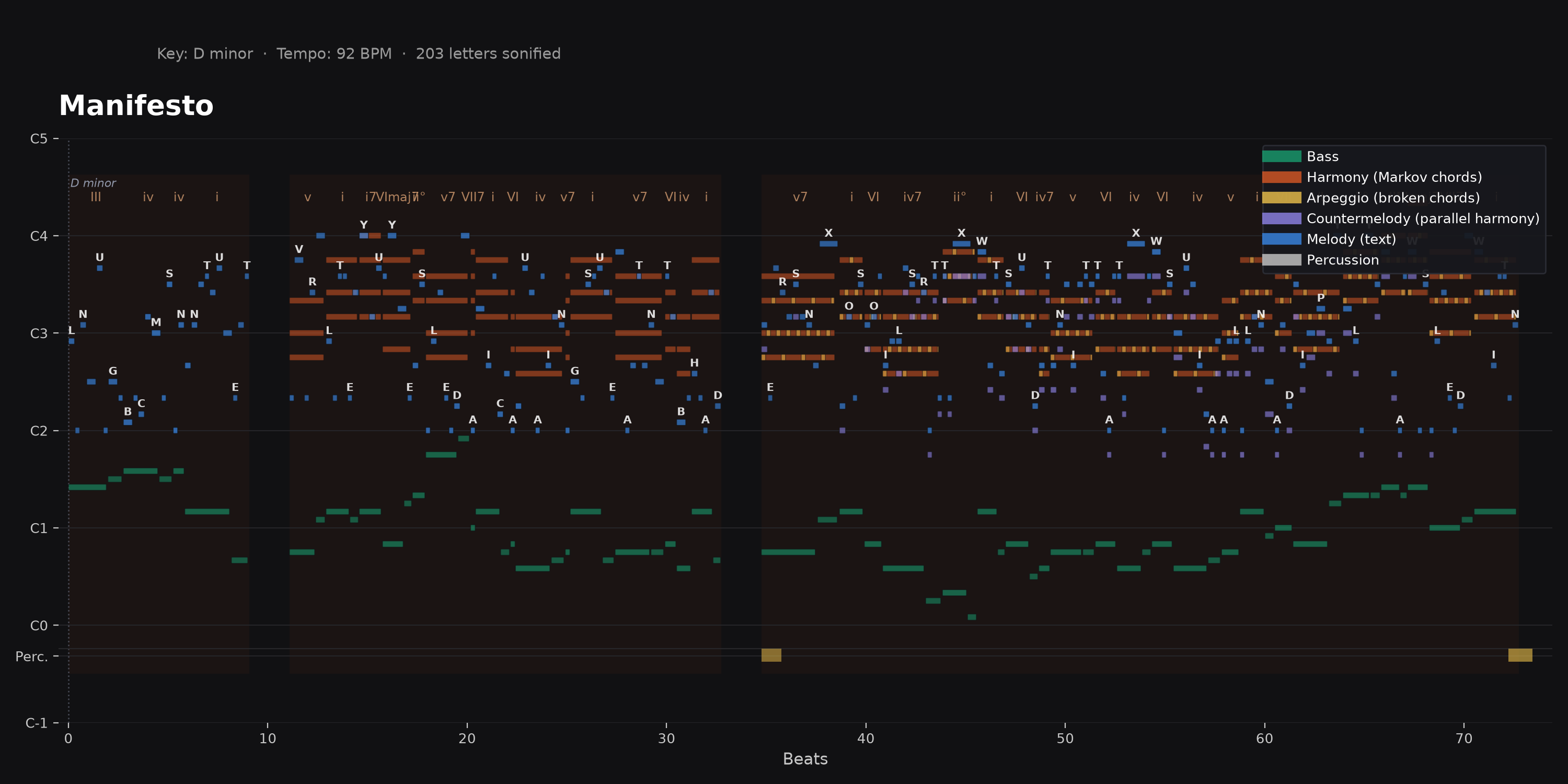
Manifesto — NeuroSonix composition
Play interactivelyEntropy
New demonstration piece · tonal melody
A short text about the engine's own rhythm rule — rare letters ringing longest — sonified by that same rule, and in tonal mode: the melody is snapped onto D minor's scale instead of staying fully chromatic, so it sits fully consonant with the same countermelody, arpeggio, bass, and percussion arrangement as Manifesto.
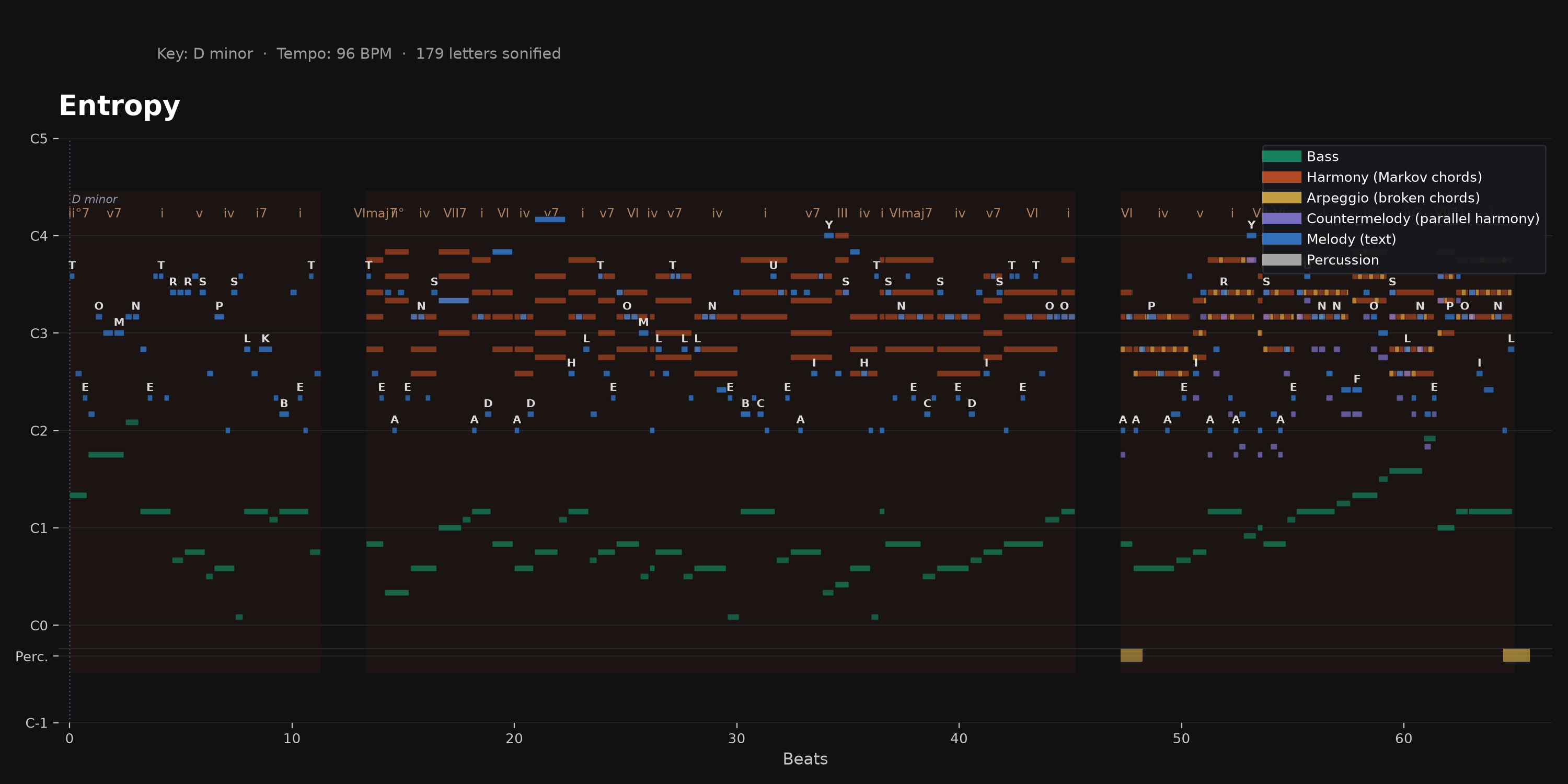
Entropy — NeuroSonix composition
Play interactivelyModulation
New demonstration piece · scale modulation
"A scale is not a fact, it is a choice of what to leave out..." — six sentences, six different modes sharing the same tonic (D dorian → phrygian → aeolian → mixolydian → lydian → major), the same words landing in a different light each time. Every scale change is marked on the piano roll with a dashed line and its name; the chord letters themselves are computed correctly for whichever mode is active at that moment, not just major and minor.
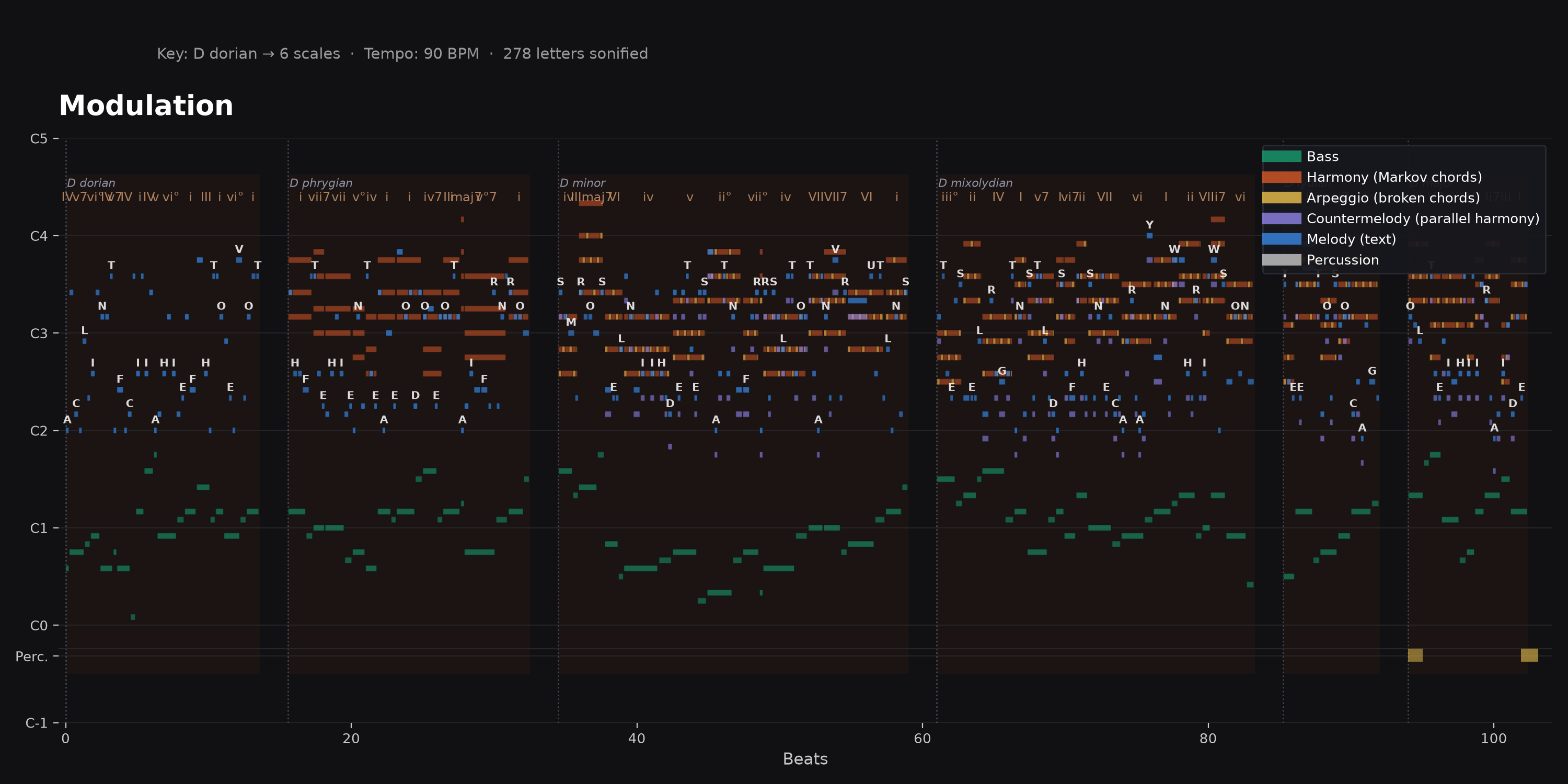
Modulation — NeuroSonix composition
Play interactivelyExplore the Full Project
Code & data
The full engine, its source, and both demonstration pieces are documented on GitHub, alongside the original 2024 prototype.
View on GitHub Connect on LinkedIn